War Memorial
The Kargil War: A Saga of Ultimate Valor
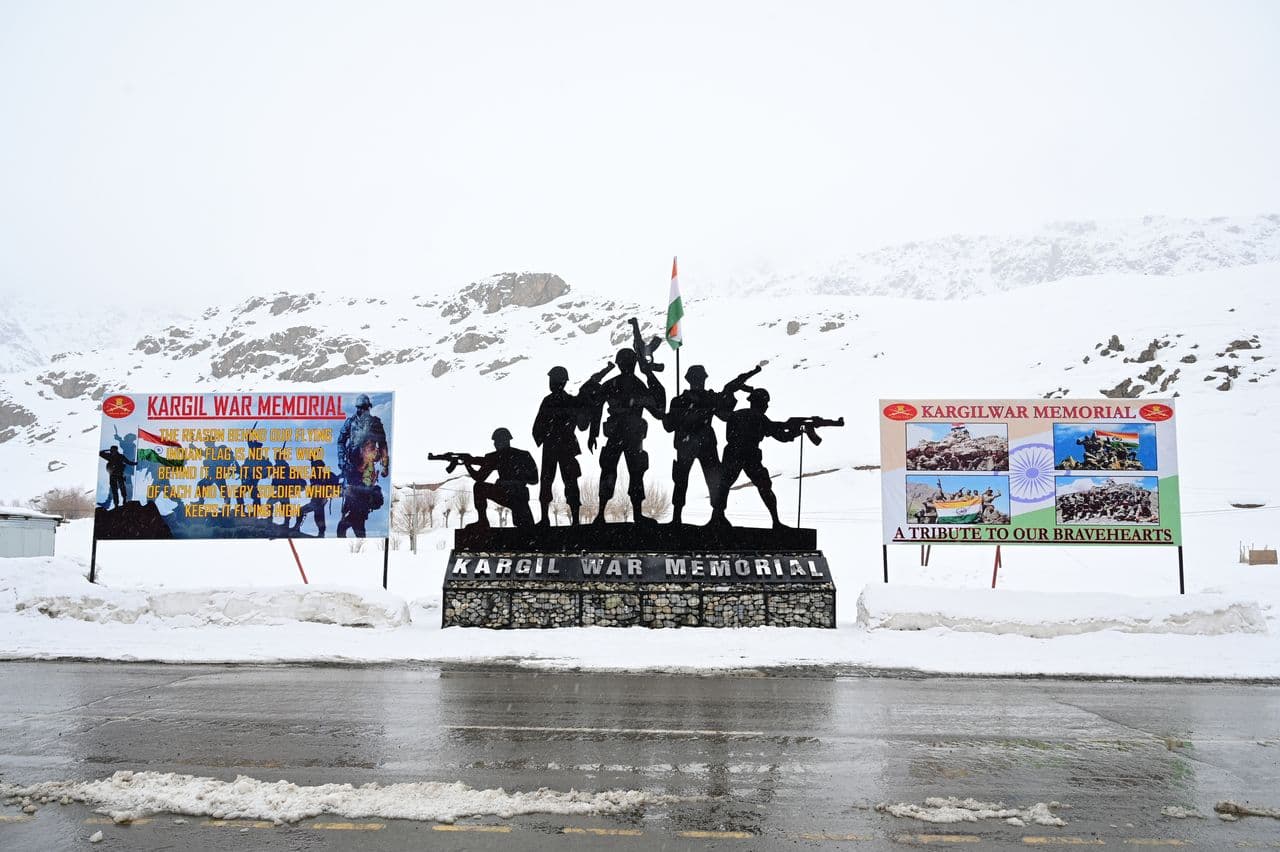
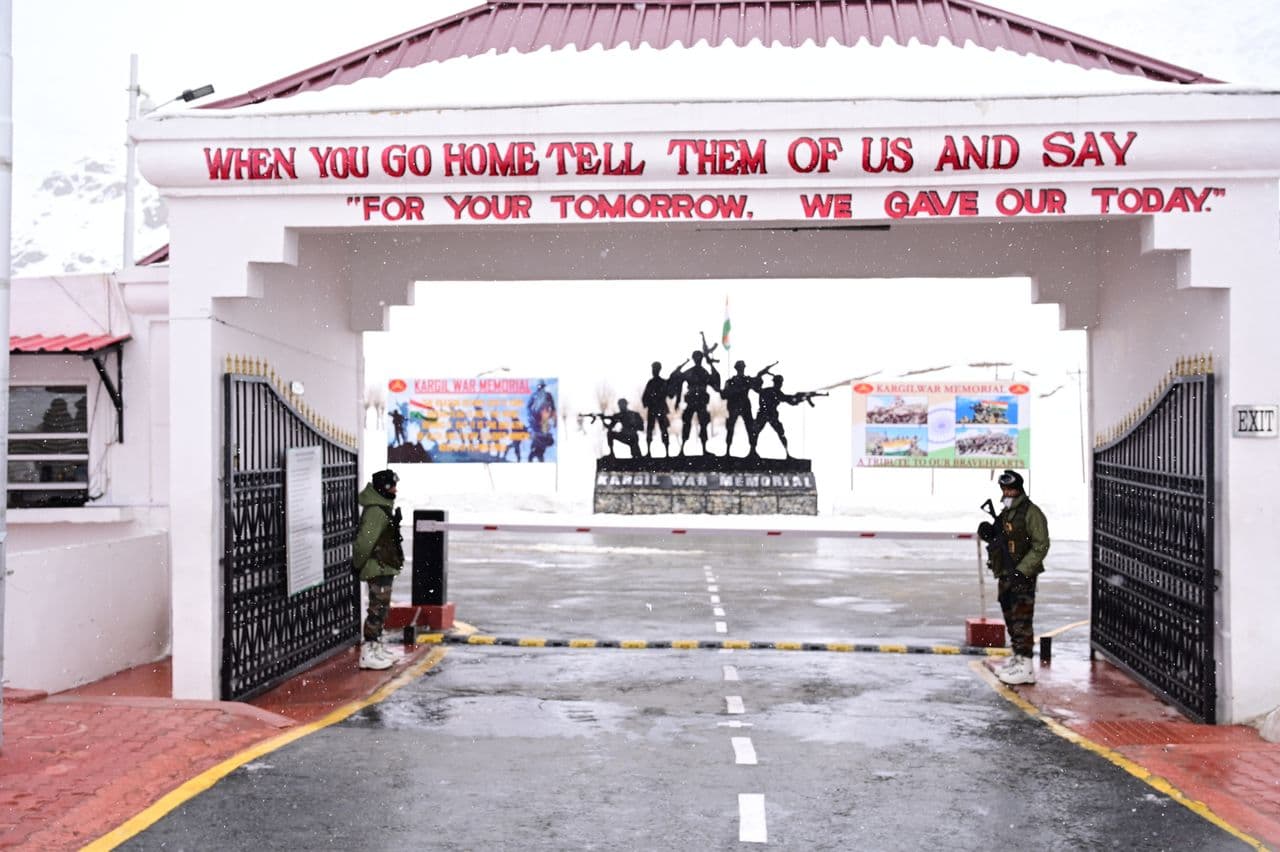
On Fame’s eternal camping ground, Their silent tents are spread, And glory guards with solemn round— The bivouac of the dead. The Kargil War Memorial, stands as an eternal sentinel of remembrance, standing in tribute to the warriors who fought with undying courage in the Kargil War of 1999. Built in November 2004, this sacred ground was chosen for its historical gravity, as it bears witness to some of the fiercest battles fought in the conflict. Here, you stand at the very heart of history, overlooking the very terrain where Pakistan's army intruded and where Indian soldiers, armed with unbreakable resolve, reclaimed every inch of their motherland. At an altitude of 10,500 feet above sea level, you are merely 9 kilometers from the Line of Control (LoC). Towering behind the Cenotaph is the formidable Tololing Hill, standing at 15,100 feet, a silent witness to the heroism that unfolded here. Now, if you look to the left of the Cenotaph in the skyline, you will see Tiger Hill, its black triangular peak piercing the sky at 16,700 feet. To its left, stands Rhino Horn, jagged and fierce, and further beyond is Point 4875, re-named as Batra Top, in honour of Captain Vikram Batra, Param Vir Chakra. This peak soars at 16,000 feet above the sea. In the summer of 1999, these heights bore witness to unyielding battles. Across the Dras, Kargil, Batalik, and Turtuk sectors, the enemy had entrenched themselves in near-impenetrable positions. Tololing Hill, the towering guardian behind the Cenotaph, dominated National Highway 1, raining devastation below. Yet, the 18 Grenadiers, braving relentless fire, forged the path for victory. 2 Rajputana Rifles and 18 Garhwal Rifles reinforced the assault, and on 13th June 1999, Major Vivek Gupta and his team of 2 Rajputana Rifles reclaimed Tololing Hill in hand-to-hand combat. In his final moments, Major Gupta stood unbowed, earning the Maha Vir Chakra, alongside Major R.S. Adhikari of 18 Grenadiers. With Tololing in Indian hands, the battle turned to the towering might of Tiger Hill, from where enemy artillery rained destruction upon the Dras Valley and the highway. The valiant 18 Grenadiers and 8 Sikh battalions ascended its treacherous heights, launching their assault on 2nd July 1999. The Ghatak Platoon of 18 Grenadiers, scaling a sheer vertical cliff, launched a surprise attack from the east, while the main force advanced from the south and southeast. 8 Sikh flanked from the west, encircling the enemy in a storm of unrelenting fire. On 11th July 1999, Tiger Hill was recaptured. For his unparalleled gallantry, Grenadier Yogendra Singh Yadav of 18 Grenadiers was awarded the Param Vir Chakra, and his Ghatak Platoon Commander, Lieutenant Balwan Singh, received the Maha Vir Chakra. While the battle for Tiger Hill raged, 13 Jammu & Kashmir Rifles, 17 JAT, and 2 Naga launched a relentless offensive on Point 4875. Amidst the tempest of war, Captain Vikram Batra led his men with fearless defiance, before falling in the heat of battle. Posthumously awarded the Param Vir Chakra, his name is forever etched in the annals of valour. Rifleman Sanjay Kumar of his unit, too, was honored with the Param Vir Chakra. Across the Batalik sector, 1/11 Gorkha Rifles stormed Khalubar Hill, where Captain Manoj Kumar Pandey, his spirit unyielding, sacrificed his life, earning the Param Vir Chakra in his final breath. The Ladakh Scouts, the warriors of ice and stone, played a pivotal role. Their fearless charge in the Chorbatla sector, led by Major Sonam Wangchuk, was a masterstroke of strategy and grit, earning him the Maha Vir Chakra. At the world's highest battlefronts, the South Siachen Glacier and Turtuk, 11 Rajputana Rifles, 9 Mahar, 13 Kumaon, and 27 Rajput reclaimed strategic peaks—Point 5590, Point 5220, and Point 5770. Among these warriors, Captain Haneef Uddin of 11 Rajputana Rifles fell, his sacrifice immortalized in the renaming of Turtuk Sub-sector as "Sub-Sector Haneef." The earth trembled as over 2.5 lakh artillery shells rained upon enemy positions, peak by peak. Point 5140, forever marked by the thunder of guns, was named Gun Hill in tribute to the artillerymen. The sky was no less a battleground. The Indian Air Force, under Operation Safed Sagar, struck with precision, ensuring victory on the peaks. Squadron Leader Ajay Ahuja of 17 Squadron gave his life for the nation, his name forever honored with the Vir Chakra. Beyond land and sky, the Indian Navy, in Operation Talwar, turned the tides against the enemy, blockading Pakistan’s Karachi Port and severing vital supply lines. In the end, 545 warriors gave their all, their names woven into the fabric of eternity, while 1,536 bore the scars of war. This Kargil War Memorial is their voice, their song, their silent yet thunderous testimony. Some return home with battle scars; others in a flag-draped coffin. Yet though their bodies may rest, their spirit soars immortal. Jai Hind!