
War Story
FeaturedOperation Vijay Begins
The Mountains Call the Nation
In the summer of 1999, the high mountains of Kargil became the stage of one of the most difficult, courageous and defining military campaigns fought by independent India.
These were not ordinary mountains.
They were vast, cold and unforgiving heights rising above the valleys of Dras, Kargil, Mushkoh, Batalik and the remote northern reaches towards Turtuk. Their slopes were formed from loose rock, narrow ledges and near-vertical cliffs. Their ridgelines stood exposed to icy winds, sudden snow and temperatures that could fall far below freezing even when the plains of India were burning under the summer sun.
For most of the year, these heights remained silent.
They were buried beneath snow, cut off by avalanches and abandoned to the wind. Human movement was difficult. Survival itself required preparation. The thin air reduced physical strength, the cold numbed the body and the terrain punished every careless step.
But in 1999, the silence of these mountains was broken.
Enemy forces had crossed the Line of Control and occupied a series of dominating heights on the Indian side. They had established positions on ridges overlooking important valleys, tracks and communication routes. What appeared at first to be limited infiltration gradually revealed itself as a carefully prepared military intrusion.
The enemy had not merely crossed into Indian territory.
They had climbed to commanding positions, constructed stone sangars, established bunkers, stocked weapons and ammunition and created observation posts from which they could monitor movement far below.
The mountains had become watchtowers of danger.
From these heights, enemy troops could observe Indian positions and direct fire onto the approaches. They could threaten supply columns, interfere with troop movement and place pressure on one of the most important roads in the entire region—National Highway 1.
This highway connected Srinagar to Kargil and Leh.
On a map, it appeared to be a road winding through the mountains.
On the battlefield, it was a lifeline.
Through this road travelled troops moving towards the front. Ammunition for artillery and infantry units was transported along it. Food, fuel, medical supplies and engineering equipment followed the same route. Reinforcements moving into Ladakh depended upon it. Wounded soldiers returning from the battlefield were carried over sections of this road.
It was more than a line of communication.
It was the artery through which the strength of the nation reached the mountains.
If the highway remained under continuous enemy observation and fire, India’s ability to sustain military operations in Kargil and Ladakh could be severely affected. Every convoy moving along the road carried the risk of enemy shelling. Every bend in the valley could be observed from the heights above.
Yet the road did not stop functioning.
Through fire, smoke and uncertainty, vehicles continued to move. Drivers crossed exposed stretches knowing that enemy guns could open fire at any moment. Engineers repaired damaged portions. Soldiers guarded the route. Supplies continued to reach the front.
The highway became a silent participant in the war.
It carried no weapon of its own, but it carried the men and material that made victory possible. It witnessed the movement of battalions towards battle, artillery guns towards their firing positions and ambulances carrying the wounded away from the mountains.
It remained the connection that kept the war effort alive.
The first signs of the intrusion emerged through local information, patrol reports and battlefield observation. In the beginning, the situation was not fully understood. The rugged terrain, winter isolation and scattered nature of the enemy positions made it difficult to determine the scale of what had occurred.
At first, it appeared that small groups of infiltrators had entered the region.
But as patrols moved forward and contact with the enemy increased, the truth became clear.
This was not a temporary presence.
The enemy had occupied multiple heights across a broad front. Their positions had been prepared in advance. Ammunition and supplies had been carried to the ridges. Observation posts had been established. Heavy and automatic weapons had been deployed in stone defences protected by the natural strength of the mountains.
India now faced one of the hardest situations possible in warfare.
The enemy was above.
The Indian soldier had to attack from below.
In mountain warfare, height is not merely an advantage—it can decide the entire character of a battle.
A defender positioned on a summit or ridgeline can see the approach of the attacking troops. He can fire downwards from protected positions. He can prepare his weapons in advance and identify the narrow routes through which the attackers must climb.
The attacking soldier, meanwhile, must move across exposed ground.
He must climb while carrying his rifle, ammunition, grenades, communication equipment, protective clothing and essential supplies. The steep ascent slows him down. The rarefied air reduces his strength. The rocky slopes provide little cover.
Every upward step brings him closer to the enemy’s weapons.
The enemy often remained hidden behind stone sangars until the attacking troops entered the effective range of machine guns and rifles. Artillery fire could support the assault, but the final distance still had to be crossed by infantrymen on foot.
There was no road to the summit.
There was no vehicle that could carry a soldier into the enemy bunker.
The last few hundred metres belonged to the infantry.
India’s response was launched under the name Operation Vijay.
The name meant victory.
But victory in Kargil would not come quickly or easily.
Operation Vijay required the mobilisation of troops, artillery, aviation, logistics, intelligence, engineering and medical support across some of the most difficult terrain in the world. Infantry battalions were moved towards the affected sectors. Artillery regiments established firing positions. Supply systems were reorganised to support a prolonged high-altitude campaign.
The response grew from a military operation into the organised will of a nation.
Across India, families watched the news from the front. Soldiers travelled towards the mountains. Units prepared for missions whose objectives were marked not by cities or bridges, but by numbers and names on steep ridgelines.
Tololing.
Tiger Hill.
Point 4875.
Point 5140.
Khalubar.
Jubar.
Point 5203.
These names would soon enter the history of the Indian Army.
Each represented a height occupied by the enemy.
Each had to be approached, isolated and captured.
Each demanded sacrifice.
The Indian Army began the difficult task of recovering the occupied positions feature by feature. Infantry units climbed towards enemy defences under the cover of darkness. Many assaults began at night because daylight movement would expose troops to observation and direct fire.
The darkness provided concealment, but it also created new dangers.
Soldiers moved over loose stones without being able to see the ground clearly. They climbed narrow ridges where one wrong step could lead to a fatal fall. They carried heavy equipment while trying to remain silent. They could not use lights because even a small glow could reveal their position.
The mountain became a test of discipline before the enemy was even encountered.
At several objectives, the troops climbed throughout the night, only to begin the final assault at dawn. Exhausted and short of breath, they still had to fight through enemy fire and clear fortified positions at close range.
The battle was often reduced to its most direct form.
A soldier.
His weapon.
His comrades.
And the enemy bunker above him.
Artillery played a decisive role in supporting these operations.
The guns opened with a force that echoed across the valleys. Bofors howitzers and other artillery systems struck enemy positions on the ridgelines, destroyed sangars, disrupted supply routes and weakened defensive locations before the infantry moved forward.
The thunder of artillery became one of the defining sounds of the war.
Day and night, gun crews worked without pause. Ammunition was brought forward in enormous quantities. Fire plans were prepared to support assaults on difficult heights. Artillery observers moved with infantry formations to direct fire onto enemy positions.
The guns could break bunkers.
They could suppress machine-gun positions.
They could shake the mountain.
But they could not physically occupy the objective.
After the artillery fire lifted, the infantry still had to climb.
The Indian Air Force joined the campaign under Operation Safed Sagar.
Air operations in the high mountains presented exceptional challenges. Enemy positions were small, fortified and located on steep slopes. The altitude affected aircraft performance, while the proximity of the Line of Control demanded precision and restraint.
Indian Air Force pilots flew missions over dangerous terrain to strike enemy supply points, command positions and defensive locations. They operated under difficult conditions where the mountains rose sharply beneath the aircraft and enemy air-defence weapons remained a constant threat.
The sky had now joined the battle.
Aircraft supported the campaign from above while soldiers advanced from below. The air effort placed additional pressure on the enemy and helped isolate positions that depended upon vulnerable mountain supply routes.
At sea, the Indian Navy launched Operation Talwar.
Naval forces deployed strategically to apply pressure and demonstrate India’s ability to widen the conflict if required. The presence of the Navy strengthened the larger national response and compelled the enemy to consider dangers beyond the mountain battlefield.
The war had begun in the heights of Kargil, but India’s answer extended across land, air and sea.
The Army fought to recapture the peaks.
The Air Force struck from the sky.
The Navy applied strategic pressure at sea.
Together, the three services formed a coordinated national response.
Yet at the centre of the campaign remained the infantry soldier.
It was he who climbed the final slope.
It was he who approached the sangar.
It was he who entered the bunker.
He climbed at night with a rifle in his hands and the responsibility of the mission on his shoulders. He moved through freezing wind, thin air and enemy fire. His boots slipped on loose stone. His breath became shorter with every step. The weight of ammunition pulled against his body.
He knew that the enemy held the higher ground.
He knew that his movement could be detected.
He knew that the next burst of machine-gun fire could come from any rock above him.
Still, he continued climbing.
Behind every soldier was a family waiting for news.
Behind every battalion was a regiment carrying generations of honour.
Behind every assault was a nation that expected its territory to be restored.
The soldier could not afford to fail because the objective was not merely a piece of rock. Every height represented Indian soil. Every occupied ridge challenged the sanctity of the Line of Control. Every enemy position threatened the security of those living and serving below.
Operation Vijay was therefore not simply a campaign to reclaim ground.
It was a mission to restore honour.
It was a declaration that aggression would not be accepted.
It was a promise that every occupied feature would be recovered, regardless of the difficulty or the cost.
Across Dras, Kargil, Mushkoh and Batalik, Indian troops began turning that promise into action.
Some objectives required repeated assaults.
Some positions changed hands more than once.
Some victories were achieved only after days of artillery fire, night climbs and close-quarter combat.
At every stage, the mountains demanded sacrifice.
Officers led from the front because their men needed to see them moving towards the objective. Junior leaders took command when others were wounded. Soldiers carried injured comrades down slopes while the battle continued above. Artillery crews fired until their gun barrels became dangerously hot. Pilots flew into valleys where the margin for error was almost nonexistent.
The war produced extraordinary acts of courage.
Captain Vikram Batra led assaults on Point 5140 and Point 4875.
Captain Manoj Kumar Pandey fought bunker by bunker on Khalubar Ridge.
Lieutenant Manoj Kumar Pandey’s Gorkhas, the soldiers of Jammu and Kashmir Rifles, Rajputana Rifles, Grenadiers, Sikh, Naga, Garhwal Rifles, Jammu and Kashmir Light Infantry, Ladakh Scouts and many other units fought across isolated heights.
Lieutenant Vijayant Thapar wrote to his family before making the supreme sacrifice.
Grenadier Yogendra Singh Yadav climbed through enemy fire.
Rifleman Sanjay Kumar charged enemy positions despite his wounds.
Major Rajesh Adhikari, Major Vivek Gupta, Captain Anuj Nayyar, Captain Haneef Uddin, Captain Keishing Clifford Nongrum and many others became inseparable from the features on which they fought.
Some names became known throughout the nation.
Many others remained known mainly to their comrades and families.
But every soldier was part of the same victory.
Operation Vijay was won not through one battle, one unit or one heroic act. It was created through hundreds of coordinated efforts—some dramatic, some quiet, all essential.
A porter carrying ammunition towards a forward post contributed to the victory.
A driver moving a convoy along the threatened highway contributed to the victory.
A gunner loading another artillery shell contributed to the victory.
A doctor treating casualties in a field hospital contributed to the victory.
A soldier holding an isolated position through the night contributed to the victory.
The campaign was a chain of duty in which every link mattered.
As Indian forces recaptured the occupied heights, the enemy’s defensive system began to collapse. Positions that had once overlooked the valleys were cleared. Ridgelines were restored to Indian control. The national flag returned to peaks where soldiers had fought through fire and freezing darkness.
Victory came ridge by ridge.
Sangar by sangar.
Metre by metre.
The mountains that had become watchtowers of danger were transformed into monuments of courage.
Operation Vijay proved that technological support, artillery power and strategic coordination were vital—but human courage remained decisive. Machines could strike the objective, but men had to occupy it. Plans could identify the route, but soldiers had to climb it.
No weapon could replace determination.
No altitude could defeat resolve.
No bunker could remain secure when confronted by soldiers who refused to turn back.
The Kargil War Memorial exists because of these men.
It stands not only to record a military victory, but to preserve the memory of those who made that victory possible. Its pathways, galleries, weapons, photographs and memorial stones are not separate exhibits. They are chapters of one connected story that began when the scale of the intrusion became clear and India answered with Operation Vijay.
The visitor’s journey begins here.
From this opening story flows everything that follows.
Vijay Path recalls the soldiers and the battles that carried India towards victory.
The Cenotaph honours those who did not return.
The Photo Gallery preserves moments of courage, comradeship and sacrifice.
The Bofors gun represents the thunderous artillery support that broke enemy defences.
The MiG-21 and the story of Operation Safed Sagar recall the air warriors who entered the mountain battlefield from the sky.
The Captured Weapon Gallery shows the weapons and equipment recovered from positions that the enemy believed would remain secure.
The section Beyond the Battlefield remembers the families, medical personnel, porters, engineers, drivers and citizens whose contribution extended far beyond the firing line.
Every part of the memorial returns to the same beginning.
The moment when the nation understood the danger.
The moment when soldiers received their orders.
The moment when the first troops looked towards the impossible heights and began to climb.
Operation Vijay is the opening of the Kargil saga because it explains why these mountains are sacred.
Before the war, they were remote geographical features.
After the war, they carried the names of heroes.
Before the war, the ridges were known mainly to soldiers and local communities.
After the war, Tololing, Tiger Hill, Point 4875 and Khalubar became part of the national memory.
The frozen heights were transformed into immortal ground.
This is the story the visitor must carry forward while walking through the memorial.
The weapons on display were once used in battle.
The photographs were once living moments.
The names carved in stone belonged to sons, brothers, husbands, fathers and comrades.
The peaks visible in the distance were not captured by words or symbols.
They were captured by soldiers.
Operation Vijay was the answer of a nation whose territory had been challenged.
It was the strength of the three services acting together.
It was the roar of artillery across the valleys.
It was the courage of pilots over the mountains.
It was the strategic pressure of ships at sea.
Above all, it was the relentless climb of the Indian infantryman.
He climbed when the air was too thin.
He climbed when the slope was too steep.
He climbed when the enemy was waiting above.
He climbed because the land had to be reclaimed.
He climbed because honour demanded it.
He climbed because India had called.
And when he reached the summit, he proved that no height was too high for Indian courage.
Operation Vijay was not merely the beginning of a military campaign.
It was the moment when frozen mountains became battlefields, soldiers became legends and sacrifice became immortal.
It was the call that brought a nation together.
It was the journey from intrusion to liberation.
It was the beginning of victory.
Location
- Dras–Kargil–Batalik–Mushkoh–Turtuk belt
Forces Involved
 18th Battalion, The Grenadiers18 Grenadiers
 18th Battalion, The Garhwal Rifles18 Garh Rif
 2nd Battalion, The Rajputana Rifles2 Raj Rif
 8th Battalion, The Sikh Regiment8 Sikh
 13th Battalion, The Jammu and Kashmir Rifles13 JAK RIF
 17th Battalion, The Jat Regiment17 Jat
 2nd Battalion, The Naga Regiment2 Naga
Roll of Honour
- Captain Jintu Gogoi18th Battalion, The Garhwal Rifles
- Major Mariappan Saravanan1st Battalion, The Bihar Regiment
- Captain Vijayant Thapar2nd Battalion, The Rajputana Rifles
- Captain Keishing Clifford Nongrum12th Battalion, The Jammu and Kashmir Light Infantry
- Captain Saurabh Kalia4th Battalion, The Jammu and Kashmir Rifles
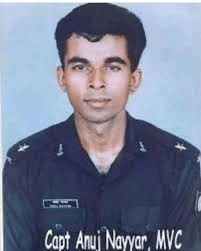 Captain Anuj Nayyar17th Battalion, The Jat Regiment
- Major Padmapani Acharya2nd Battalion, The Rajputana Rifles
- Major Vivek Gupta2nd Battalion, The Rajputana Rifles
- Major Rajesh Singh Adhikari18th Battalion, The Grenadiers
- Havildar Ganga Ram DasCorps of Electronics and Mechanical Engineers
- Naik Sachidananda Mallick12th Battalion, The Mahar Regiment
- Naik Srinivas S. Patra12th Battalion, The Mahar Regiment
- Captain Gurjinder Singh Suri12th Battalion, The Bihar Regiment
- Lieutenant Manoj Kumar Pandey1st Battalion, 11 Gorkha Rifles
- Captain Neikezhakuo Kenguruse2nd Battalion, The Naga Regiment
- Signalman Manas Ranjan SahuCorps of Signals
- Captain Vikram Batra13th Battalion, The Jammu and Kashmir Rifles