
War Story
Pimple 2
Captain Anuj Nayyar’s Last Command
In the rugged heights of the Mushkoh sector stood Pimple II, a strongly defended mountain feature that became the setting for one of the most courageous examples of battlefield leadership during Operation Vijay.
The position formed part of a larger network of enemy-held ridges, rocky projections and fortified locations across the Mushkoh Valley. These features were not isolated from one another. A bunker on one height could support troops occupying another. Machine guns could cover the narrow approaches, while observation posts could monitor Indian movement and direct mortar or artillery fire onto the climbing soldiers.
Pimple II had been prepared for defence.
Stone sangars blended with the broken mountain terrain. Machine-gun positions were placed to dominate the likely routes of approach. The defenders occupied the higher ground and could watch Indian troops climbing from below.
For the attacking soldiers, there was almost no concealment.
The slopes were steep, rocky and exposed. Every man carried his rifle, ammunition, grenades and essential equipment while climbing through thin air. Soldiers responsible for machine guns, radio sets and rocket launchers carried even heavier loads.
The physical effort required simply to reach the battlefield was enormous.
But once the troops came within range of the enemy positions, the mountain gave them no opportunity to recover.
A Feature Designed to Stop the Advance
The enemy had arranged its defences so that the Indian troops would be exposed during the final approach.
A machine gun could fire along a narrow ridge and prevent soldiers from spreading out. A fortified sangar could remain concealed until the assaulting troops entered its effective range. Mortars and artillery could strike areas where Indian soldiers were likely to gather or take cover.
In ordinary terrain, an attacking force might bypass a strong position or approach it from several directions.
At Pimple II, the mountain restricted movement.
Steep drops, rocky outcrops and narrow approaches channelled soldiers towards areas already covered by enemy weapons. The attackers often had little choice but to confront the fortified positions directly.
The enemy understood this advantage.
They expected the combination of altitude, exposed terrain and defensive fire to break the Indian assault before it reached the summit.
The soldiers of 17 Jat Regiment were tasked with proving them wrong.
The Climb Towards Battle
The assaulting troops began their movement through darkness.
Night offered some concealment from enemy observation, but it made the dangerous terrain even more difficult. The men could not use lights without revealing their position. They had to follow the soldier ahead, feeling for secure footholds and avoiding loose rocks that might roll down the slope.
Every sound mattered.
A stone falling into the darkness could alert the defenders.
A shouted instruction could reveal the direction of the approach.
A flash of light could draw immediate fire.
The soldiers climbed in silence.
The cold cut through their clothing. The thin air shortened their breath. The weight of weapons and ammunition pulled against their bodies.
At several places, the men had to use their hands to pull themselves upwards. The slopes were too steep for ordinary walking, and the loose rock made every step uncertain.
Yet the objective remained above them.
The soldiers continued climbing because Pimple II had to be captured before the larger Mushkoh operation could move forward.
The Assault Comes Under Fire
As the troops approached the enemy-held positions, the darkness was broken by gunfire.
Machine guns opened from concealed sangars.
Rifle fire struck the rocks surrounding the Indian soldiers.
Mortar and artillery fire threatened the exposed approaches.
The assaulting troops were forced to take whatever cover the terrain provided. A boulder, a depression or a small fold in the mountain could protect a few men temporarily, but remaining still was dangerous.
The enemy was above them.
Once the defenders identified the position of an Indian group, they could concentrate their fire upon it.
The assault had reached a critical point.
The troops were close enough to threaten the enemy, but still exposed beneath the fortified positions. If the advance stopped for too long, the defenders would gain time to reorganise, bring additional weapons into action and isolate the assaulting groups.
Momentum was essential.
It was then that the company suffered a serious setback.
The company commander was injured.
The Moment Command Changed Hands
The loss or injury of a commander during an assault can create immediate confusion.
Orders may become unclear.
Different groups may lose contact with one another.
Soldiers pinned down by enemy fire may hesitate while waiting for new instructions.
In mountain warfare, even a brief delay can become disastrous.
The enemy can return to damaged positions.
A machine-gun team can change location.
Reinforcements can arrive from another part of the ridge.
Mortar fire can be redirected onto the stalled assault.
The defenders can regain the initiative.
At Pimple II, there was no time to stop and reorganise through a lengthy command process.
Someone had to take charge immediately.
Captain Anuj Nayyar stepped forward.
Captain Anuj Nayyar Assumes Command
Captain Anuj Nayyar understood the danger of losing momentum.
The soldiers had already completed a difficult climb. They were under intense fire and exposed on broken mountain ground. If the attack collapsed, the men might be forced to withdraw across the same dangerous slopes, leaving the enemy in possession of the feature.
Captain Nayyar assumed command of the company.
He did not wait for the battle to become clearer.
He did not remain protected while sending others forward.
He immediately began reorganising the assault.
The troops were redirected.
Weapons were repositioned.
Covering fire was coordinated.
The leading groups were prepared to resume movement towards the enemy sangars.
His calm and decisive response prevented confusion from spreading through the company.
The soldiers knew who was commanding them.
They knew the mission remained unchanged.
They knew the assault would continue.
Leadership That Could Be Seen
Captain Nayyar’s leadership was not expressed only through radio messages or shouted instructions.
He moved towards the front.
He placed himself among the troops facing the greatest danger. He identified the enemy positions blocking the advance and personally led the effort to destroy them.
The soldiers could see their officer moving forward.
In high-altitude battle, such visible leadership carries enormous power.
The men were exhausted from climbing.
They had witnessed casualties.
The enemy occupied strong bunkers above them.
Fear and uncertainty could have weakened the assault.
But Captain Nayyar’s example gave the soldiers confidence.
He was standing in the same fire.
He was crossing the same exposed ground.
He was accepting the same danger.
His actions communicated more strongly than words:
The enemy position could be reached.
The bunkers could be destroyed.
The company would continue advancing.
Closing the Distance
The Indian troops began moving forward again.
Machine-gun teams provided suppressive fire while the assaulting soldiers advanced from one patch of cover to another. Grenades and ammunition were passed towards the leading groups.
The distance to the enemy positions gradually narrowed.
At long range, the defenders possessed the advantage. They could fire from fortified sangars while remaining protected behind stone walls.
The Indian soldiers had to enter close range before they could decisively engage them.
This required crossing exposed ground.
Captain Nayyar continued leading the troops towards the bunkers.
He studied the enemy’s firing pattern and identified the positions that had to be neutralised first. A single surviving machine gun could halt the entire company, so every active sangar had to be destroyed before the assault could continue safely.
The battle became a struggle measured in metres.
A short rush forward.
A pause behind a rock.
A burst of covering fire.
Another movement towards the objective.
Every metre gained brought the attackers deeper into the enemy’s defensive system.
The Rocket Launcher
Some of the enemy sangars were too strongly constructed to be neutralised by rifle fire alone.
Their thick stone walls protected the defenders, allowing them to continue firing upon the advancing troops. Hand grenades could be effective, but a soldier had to approach extremely close before using them.
Captain Nayyar employed a rocket launcher against the fortified positions.
The weapon provided the force necessary to damage or destroy the stone defences. But using it in the mountains was dangerous.
The launcher and its ammunition had to be carried up the difficult slopes.
The operator needed a clear view of the target.
Firing required exposure.
Enemy soldiers could identify and engage the launcher team before the weapon was brought into action.
Captain Nayyar accepted that risk.
He moved into positions from which the enemy bunkers could be engaged and directed the destruction of the sangars blocking the company’s advance.
A rocket struck an enemy position.
Rock, dust and smoke erupted from the bunker.
The assaulting troops immediately moved forward before the defenders could recover.
Bunker After Bunker
The fall of one sangar did not end the resistance.
Pimple II was defended through several interconnected positions. Each bunker covered part of the approach and supported the troops occupying the adjoining rocks.
Captain Nayyar continued moving from one enemy location to another.
The company advanced behind him.
Grenades were thrown into surviving positions.
The rocket launcher was used against strongly fortified sangars.
Riflemen engaged defenders attempting to withdraw or reinforce another bunker.
The fighting became close, violent and personal.
At such short distance, there was little time for complex orders.
Decisions had to be made immediately.
One group suppressed the enemy.
Another moved closer.
A grenade was thrown.
The position was rushed.
Then the soldiers turned towards the next sangar.
Captain Nayyar remained at the centre of the assault.
He did not simply command the movement.
He became part of it.
Refusing to Lose Momentum
The success of the attack depended upon preventing the enemy from recovering after each position was destroyed.
If the Indian troops stopped, the defenders could reorganise at the next sangar. They could shift weapons, bring up ammunition and prepare another field of fire.
Captain Nayyar therefore maintained constant pressure.
When one bunker was cleared, the troops moved towards the next.
When enemy fire temporarily halted a group, he reorganised it and resumed the assault.
When the terrain restricted movement, he identified another approach.
His leadership converted separate acts of courage into one continuous attack.
The soldiers were no longer climbing towards an unbroken line of enemy positions.
They were pushing through a defensive system that had begun to collapse.
The Officer and His Men
The courage displayed by Captain Nayyar was inseparable from his responsibility towards his soldiers.
He understood that every enemy bunker destroyed reduced the danger to the men following him.
Every metre he moved forward created space for the company to advance.
Every weapon he helped silence saved lives behind him.
This is the essence of leadership under fire.
An officer does not move forward merely to display personal bravery.
He moves because the progress and survival of his men depend upon someone taking responsibility for the danger ahead.
Captain Nayyar placed himself between the enemy and his soldiers.
He accepted the risk personally.
He led because the company needed direction.
He fought because the objective had to be captured.
The Enemy Resistance Weakens
As the Indian troops destroyed successive sangars, the enemy’s defensive arrangement began to weaken.
Positions that had once supported one another became isolated.
Machine-gun fire reduced.
The defenders were forced to react to Indian soldiers who had entered the heart of their defensive system.
The advantage of height was disappearing.
The battle was no longer between attackers below and defenders above.
Both sides were now fighting among the same rocks.
At close quarters, the courage and aggression of the assaulting soldiers became decisive.
Captain Nayyar and his men continued advancing.
The objective was moving within reach.
The Final Danger
Despite the destruction of several positions, enemy resistance remained active.
A surviving bunker or weapon could still inflict heavy casualties. The troops were operating on exposed rocky ground where concealment was limited.
Captain Nayyar continued directing the assault.
He had already taken command after his company commander was injured.
He had reorganised the men.
He had led them forward.
He had helped destroy enemy positions with the rocket launcher.
The company’s advance had been restored because he had refused to allow the battle to stop.
But the danger around him remained extreme.
During the continuing assault, Captain Anuj Nayyar was struck by enemy fire, remembered in the QR Audio Gateway narrative as an enemy rocket-propelled grenade.
He fell before he could witness the complete result of the action he had led.
Captain Nayyar made the supreme sacrifice on the battlefield.
The Battle Had Already Changed
Although Captain Nayyar did not live to see Pimple II fully secured, his actions had already transformed the battle.
When the company commander was injured, the assault could have collapsed.
Instead, Captain Nayyar assumed command.
When enemy fire stopped the advance, he reorganised the men.
When fortified bunkers blocked the route, he moved forward and helped destroy them.
When the troops needed courage, he provided it through personal example.
By the time he fell, several enemy positions had been neutralised and the defensive system had been severely weakened.
His soldiers now possessed the ground and momentum required to complete the mission.
The company continued forward.
The assault did not end with his death.
It carried the force of his leadership beyond it.
Completing the Mission
The soldiers of 17 Jat continued the attack.
They cleared the remaining resistance and secured the objective. Every sangar had to be checked. Every approach had to be covered against a possible counterattack.
The troops were exhausted, but they could not relax.
Ammunition was redistributed.
Defensive positions were established.
The wounded were treated and prepared for evacuation.
Communication with higher headquarters was restored.
The captured ground had to be held.
The men had lost the officer who had led them through the decisive stage of the battle, but the mission he had carried forward was completed.
Pimple II was secured.
The enemy’s defensive network in the Mushkoh sector suffered another major blow.
The Maha Vir Chakra
For his conspicuous courage, decisive leadership and supreme sacrifice, Captain Anuj Nayyar was posthumously awarded the Maha Vir Chakra.
The decoration recognised more than the destruction of enemy bunkers.
It recognised the moment he accepted command when the battle was in danger of losing direction.
It recognised his decision to lead from the front.
It recognised his willingness to place himself in exposed positions so that his soldiers could advance.
It recognised a young officer who continued attacking until enemy fire ended his life.
His Maha Vir Chakra became a symbol of command exercised through action.
Command Is More Than Rank
The story of Pimple II teaches that battlefield leadership is not determined by rank alone.
Rank provides authority.
Battle reveals character.
When the company commander was injured, Captain Nayyar did not simply inherit a title. He accepted responsibility for the lives of the soldiers, the momentum of the assault and the success of the mission.
He had to make decisions without delay.
He had to restore confidence while under fire.
He had to guide men who were exhausted, exposed and facing fortified positions.
He had to demonstrate that the attack remained possible.
His command was measured by what he did in that moment.
He stepped forward.
The Cost of Hesitation
Captain Nayyar understood one of the hardest truths of mountain warfare: hesitation gives strength to the defender.
An attacking force already suffers the disadvantage of climbing from below.
If it stops in exposed terrain, the enemy gains time to observe, aim and fire.
If the assaulting troops withdraw, the defenders can strengthen their sangars and prepare for the next attempt.
If command becomes uncertain, small groups can become isolated.
Maintaining momentum was therefore not a matter of aggression alone.
It was necessary for survival.
Captain Nayyar’s immediate assumption of command prevented the enemy from exploiting the injury of the company commander.
He denied the defenders the pause they needed.
His decisiveness became a tactical weapon.
Leading Through the Same Fire
The loyalty of soldiers cannot be demanded only through orders.
It is earned through shared danger.
Captain Nayyar stood in the same enemy fire as his men.
He crossed the same exposed ground.
He carried the same burden of exhaustion.
He faced the same possibility of death.
The soldiers followed because they saw that their officer would not ask them to go where he was unwilling to lead.
This is why leadership from the front became one of the defining qualities of the Kargil War.
The terrain often prevented commanders from controlling the battle from a safe distance. Young officers had to accompany their assault groups, identify routes and personally engage enemy positions.
Many paid with their lives.
But their presence gave exhausted soldiers the strength to continue.
The Men Who Continued After Him
The victory at Pimple II also belonged to the soldiers who continued the assault after Captain Nayyar fell.
They had witnessed the loss of their leader.
They were still under enemy fire.
They still had positions to clear.
Grief could not be allowed to break the company’s momentum.
The men carried forward the mission he had given them.
Riflemen advanced towards the surviving sangars.
Machine-gun teams provided covering fire.
Grenades were passed forward.
Junior leaders assumed greater responsibility.
The soldiers fought not only to capture the objective, but to honour the officer who had led them towards it.
Their continuation transformed Captain Nayyar’s sacrifice into victory.
The Unseen Courage Behind the Assault
Not every act of courage at Pimple II was recorded through a medal citation.
Soldiers carried the heavy rocket-launcher ammunition up the slope.
Men provided covering fire while others crossed exposed ground.
Radio operators maintained communication despite enemy fire and broken terrain.
Stretcher-bearers moved towards the wounded.
Ammunition was shared when supplies ran low.
Soldiers took command of weapons whose operators had been hit.
Others remained behind on captured ground to protect the assault’s flank.
These actions formed the foundation upon which individual gallantry became operational success.
Captain Nayyar became the defining hero of the battle, but he fought as part of a company whose soldiers followed him through the same danger.
The victory belonged to them all.
A Battlefield of Young Leaders
Pimple II also formed part of the larger story of young leadership across the Kargil battlefield.
Officers barely into their twenties and early thirties were given responsibility for attacks upon some of the most difficult objectives imaginable.
They had to command men in darkness.
They had to make decisions under machine-gun and artillery fire.
They had to assume command when senior officers were wounded or killed.
They had to continue operations while carrying personal grief and physical exhaustion.
Captain Anuj Nayyar represented this generation of leaders.
He was young in years, but the battlefield demanded complete responsibility from him.
He answered without hesitation.
Where Orders Became Example
Before battle, leadership can be expressed through planning, training and instructions.
At Pimple II, leadership became visible through movement.
The order to advance was embodied by Captain Nayyar advancing.
The order to destroy the bunker was embodied by him bringing the rocket launcher into action.
The order to maintain momentum was embodied by his refusal to stop.
His example gave meaning to his commands.
The soldiers did not merely hear what was required.
They saw it being done.
This is why his leadership remained powerful even after he fell.
The men understood the mission because he had shown them how it had to be completed.
The Mountain Remembers
Today, the firing has ended at Pimple II.
The machine guns no longer dominate the approaches.
The enemy sangars stand silent.
The narrow ridges no longer echo with explosions and shouted commands.
But the mountain carries the memory of the assault.
It remembers the company climbing through darkness.
It remembers enemy fire breaking across the rocks.
It remembers the moment when the commander was injured and uncertainty threatened the advance.
It remembers Captain Anuj Nayyar stepping forward.
It remembers the rocket launcher striking enemy bunkers.
It remembers soldiers following their officer into close combat.
It remembers the sacrifice that carried the assault towards victory.
Command Under Fire
Pimple II should be narrated above all as a story of command under fire.
It was a moment when leadership could not wait for safety.
It could not depend upon ideal communication.
It could not pause for lengthy orders.
The battle demanded someone who would accept responsibility immediately.
Captain Anuj Nayyar became that leader.
He took command when his company needed direction.
He reorganised the assault when enemy fire threatened to stop it.
He destroyed fortified positions when the route ahead appeared blocked.
He stood in the same danger as his soldiers.
He continued until he made the supreme sacrifice.
His story tells every visitor that leadership is not measured only by the authority a man possesses.
It is measured by the responsibility he accepts.
It is measured by the danger he is willing to face.
It is measured by the confidence he gives to others.
It is measured by whether the mission continues after he is gone.
The Final Legacy
Captain Anuj Nayyar did not live to see the full result of his assault.
But the company advanced because he had taken command.
The enemy bunkers were destroyed because he had moved forward.
Pimple II was secured because his soldiers continued the mission he had led.
His life ended on the mountain.
His leadership did not.
It remained in the men who followed him.
It remained in the captured ground.
It remained in the history of 17 Jat.
It remained in the Maha Vir Chakra awarded in his honour.
It remains wherever young soldiers are taught what it means to command in battle.
At Pimple II, Captain Anuj Nayyar showed that leadership is not standing behind men and directing them towards danger.
It is walking ahead of them.
It is accepting the first fire.
It is carrying responsibility when another leader falls.
It is refusing to allow fear or confusion to stop the mission.
The enemy held the height.
Captain Nayyar led his men upwards.
The enemy protected its bunkers with stone.
He brought the weapon needed to destroy them.
The enemy attempted to stop the assault.
He ensured that it continued.
He fell before the battle was over—
but because he had led from the front, his soldiers finished it.
Pimple II was captured through courage.
It was carried forward through leadership.
And it was made immortal by a young officer who stepped forward when the battle demanded command.
Location
- Pimple 2, Mushkoh Sector
Forces Involved
 17th Battalion, The Jat Regiment17 Jat
Roll of Honour
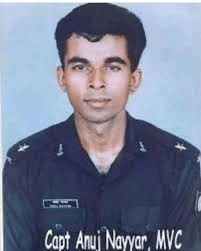 Captain Anuj Nayyar17th Battalion, The Jat Regiment