
War Story
Point 4875 / Batra Top
Where Courage Became a Name
Deep within the Mushkoh Valley stood Point 4875, one of the most strategically important and fiercely contested mountain complexes of Operation Vijay.
Its long, broken ridgeline dominated the surrounding landscape and overlooked a substantial stretch of National Highway 1, the vital road connecting Srinagar, Kargil and Leh. From observation posts established upon the height, enemy troops could monitor Indian movement across the valley, identify troop and supply concentrations and direct accurate artillery fire onto the highway and adjoining positions.
Every convoy travelling below was vulnerable.
Every movement of troops could be observed.
Every reinforcement heading towards the battlefront could be brought under fire.
Point 4875 was therefore not merely another occupied height. It was a major element of the enemy’s defensive network across the Dras–Mushkoh region. Its capture was essential to weaken enemy control over the valley, protect the national highway and create the conditions for further Indian operations.
But the feature was vast, steep and heavily defended.
It was not a single summit that could be secured through one assault. The complex consisted of several interconnected ridges, rocky projections and fortified positions. Among the most fiercely contested locations were Flat Top, Area Ledge and Pimple II.
Each position supported the others.
A machine gun on one feature could fire upon troops climbing towards another. Enemy observers could monitor the approaches and call down mortar or artillery fire. Stone sangars had been constructed among the rocks, allowing the defenders to remain protected while engaging Indian troops advancing from below.
The battlefield stretched across narrow ridgelines where movement was slow and dangerous.
There was little cover.
There was almost no space to manoeuvre.
At several places, soldiers had to advance along exposed rocky ground with steep drops on either side. The enemy occupied prepared positions above, while the attacking troops had to climb in freezing conditions carrying rifles, ammunition, grenades and communication equipment.
The mountain gave the defenders every advantage.
The Indian soldiers would have to overcome it through courage.
The Battle for the Mushkoh Heights
The task of clearing the Point 4875 complex involved 13 Jammu and Kashmir Rifles, supported by the efforts of 17 Jat, 2 Naga and other formations fighting against adjoining objectives across the Mushkoh sector.
The operation was not confined to one night or one direction.
Different units fought separate but interconnected battles across the ridgelines. Each objective had to be captured so that the enemy’s defensive system could be gradually dismantled.
The terrain divided the battlefield into small groups of soldiers fighting isolated actions among rocks and sangars. Commanders could prepare the overall plan, but once the assault began, young officers, junior commissioned officers and soldiers had to take immediate decisions under fire.
A machine-gun position could stop an entire company.
A single surviving sangar could threaten troops moving across the summit.
A counterattack could erase hours of climbing and sacrifice.
Every foothold had to be defended.
Every bunker had to be cleared.
Every gain had to become permanent.
It was within this brutal environment that three names became inseparable from the story of Point 4875:
Rifleman Sanjay Kumar.
Captain Anuj Nayyar.
Captain Vikram Batra.
Their actions occurred at different locations within the larger battle, but each displayed the same fighting spirit—a willingness to move towards the greatest danger so that others could advance.
Flat Top — The Scout at the Front
During the assault on Flat Top, the soldiers of 13 Jammu and Kashmir Rifles faced a strongly defended enemy position.
The approach was steep and exposed. The assaulting troops had to move through rocky ground while enemy weapons covered the likely routes towards the objective.
At the front of the group was Rifleman Sanjay Kumar.
He had volunteered to serve as the leading scout.
The role placed him ahead of the main body of troops. He was responsible for identifying the route, detecting enemy positions and guiding the soldiers following behind him.
In mountain warfare, the leading scout carries an extraordinary burden.
He is often the first to enter the enemy’s field of observation.
He is the first to encounter mines, hidden bunkers or sudden fire.
He must make immediate decisions that determine whether the entire assault group can continue.
Rifleman Sanjay Kumar moved ahead through the difficult terrain.
As the troops approached the objective, an enemy machine-gun position opened fire.
The weapon dominated the route and immediately stopped the Indian advance. Bullets struck the surrounding rocks, forcing the assaulting soldiers to take cover.
The machine gun had created a deadly barrier.
As long as it remained active, the company could not move forward. Any attempt to cross the exposed ground would result in severe casualties.
The enemy had the protection of a fortified position.
The Indian soldiers were trapped below.
Someone had to silence the weapon.
The Charge Towards the Machine Gun
Rifleman Sanjay Kumar took that responsibility upon himself.
He moved towards the enemy bunker.
There was no safe route.
There was no possibility of remaining concealed for the entire approach.
He had to advance across ground already covered by enemy fire.
As he moved forward, he was wounded.
The injury could have forced him to stop. He could have waited for medical assistance or allowed another soldier to continue the assault.
But the machine gun was still firing upon his comrades.
The advance remained halted.
Rifleman Sanjay Kumar continued.
He closed the distance between himself and the enemy position, moving through pain and direct fire. He reached the bunker and engaged the defenders at close range.
The battle was no longer fought from opposite sides of a mountain slope.
It became a direct struggle inside and around the fortified position.
Rifleman Sanjay Kumar neutralised the enemy soldiers occupying the bunker and captured their machine gun.
The weapon that had stopped the Indian advance was now in his hands.
But his action did not end there.
Turning the Enemy’s Weapon Against Them
Despite his wounds, Rifleman Sanjay Kumar did not withdraw for treatment.
He understood that the enemy’s remaining positions were still active and that the opportunity created by his charge had to be exploited immediately.
Using the captured machine gun, he opened fire upon the retreating defenders and the next enemy position.
The sudden reversal created confusion.
Moments earlier, the machine gun had been firing down upon the Indian troops.
Now its fire was directed against the enemy.
Rifleman Sanjay Kumar continued advancing with the captured weapon, pressing the attack before the defenders could reorganise.
His action broke the resistance facing the company.
The soldiers behind him rose from cover and resumed the assault. The position that had appeared capable of stopping the entire advance was overwhelmed through the courage of one rifleman who refused to remain pinned down.
His charge did more than destroy a bunker.
It restored momentum to the battle.
It opened the route for his comrades.
It demonstrated that even a fortified machine-gun position could be defeated when a soldier was willing to move directly towards it.
For his extraordinary courage, determination and disregard for personal safety, Rifleman Sanjay Kumar was awarded the Param Vir Chakra, India’s highest award for gallantry in the face of the enemy.
His story became one of the defining examples of individual bravery during Operation Vijay.
Pimple II — Another Fortress on the Ridge
Elsewhere within the larger Point 4875 battle, troops of 17 Jat were fighting for Pimple II.
The enemy had established a series of fortified sangars across the feature. The positions were placed among rocks and defended with machine guns and small arms.
The approach offered little protection.
Indian soldiers had to climb towards the enemy while remaining exposed to fire from above and from adjoining positions.
The battle demanded coordinated movement across extremely restricted terrain. Assault groups could not spread out widely because the narrow ridgeline limited their options. If one bunker remained active, it could hold up troops advancing behind it.
During the operation, the company commander was injured.
The assault could easily have lost direction at a critical moment.
The soldiers were under fire.
The objective had not been secured.
Immediate leadership was required.
Captain Anuj Nayyar Assumes Command
Captain Anuj Nayyar stepped forward and assumed command.
He understood that hesitation would allow the enemy to recover and strengthen its resistance. The assault had to continue before the defenders could reinforce their positions or concentrate their fire upon the exposed troops.
Captain Nayyar reorganised the men and pressed the attack.
He led from the front, moving towards the enemy’s fortified sangars rather than directing the battle from behind.
The positions had to be destroyed one by one.
Captain Nayyar used hand grenades and a rocket launcher against the bunkers. He moved across the dangerous ridgeline, identifying the enemy locations and leading his soldiers towards them.
Each sangar presented a separate threat.
The enemy remained protected behind stone walls.
The Indian troops had to approach close enough to use grenades or direct-fire weapons.
After one position was destroyed, the assault group had to immediately turn towards the next.
There was no opportunity to rest.
The battlefield demanded constant movement.
Captain Nayyar continued advancing from bunker to bunker.
His leadership gave confidence to the soldiers following him. They saw their officer moving ahead, exposing himself to the same fire and danger that they faced.
His actions communicated the clearest possible command:
The objective was ahead.
The assault would not stop.
Clearing the Sangars
The fighting around Pimple II was violent and extremely close.
Captain Nayyar and his men used grenades to clear fortified positions. The rocket launcher provided the force required to damage sangars protected by thick rock.
As the enemy’s positions were neutralised, the Indian troops moved further along the feature.
The defenders attempted to maintain their hold from the surviving bunkers. Fire continued from different directions, and every advance exposed the soldiers to new threats.
Captain Nayyar remained with the leading elements.
He helped destroy several enemy positions and created the conditions necessary for his men to continue towards the objective.
The success of the assault depended upon momentum.
Stopping on the exposed ridgeline would have allowed the enemy to concentrate fire and launch a counterattack. Captain Nayyar therefore kept the troops moving forward even as the battle became more dangerous.
After helping neutralise several sangars, he was struck by enemy fire.
Captain Anuj Nayyar made the supreme sacrifice on the feature he had helped his men capture.
His leadership had ensured that the assault continued after his company commander was injured. His courage had carried the soldiers through the enemy’s defensive line. His actions had transformed a moment of uncertainty into a determined advance.
For his exceptional gallantry and sacrifice, Captain Anuj Nayyar was posthumously awarded the Maha Vir Chakra.
The victory at Pimple II became inseparable from his name.
The Final Phase of the Point 4875 Battle
As different positions across the complex were captured, the battle entered its most difficult phase.
The enemy still occupied locations near the final objectives. These positions had to be cleared before the entire feature could be declared secure.
The soldiers fighting on the heights were exhausted.
They had climbed through difficult terrain, fought at close range and suffered casualties. Ammunition and supplies had to be carried across exposed routes. The wounded required evacuation down dangerous slopes.
Yet the enemy remained active.
Counterattacks were possible.
A surviving machine gun could still threaten the entire ridgeline.
Additional troops were needed to strengthen the assault and complete the operation.
It was during this phase that Captain Vikram Batra volunteered to return to battle.
Captain Vikram Batra Returns to the Heights
Captain Vikram Batra had already established a remarkable reputation during the capture of Point 5140.
There, he had led his soldiers through darkness, attacked from an unexpected direction and cleared enemy positions at close range. His victory signal—“Yeh Dil Maange More!”—had become a symbol of the confidence and offensive spirit of the Indian Army.
But Captain Batra did not consider his responsibility complete.
At Point 4875, Indian troops were engaged in another critical battle. The final enemy positions had to be neutralised, and reinforcements were needed.
Despite illness, fatigue and the physical exhaustion of continuous high-altitude operations, Captain Batra insisted on returning to action.
He understood the condition of the soldiers already fighting on the ridge.
He knew the difficulties of the terrain.
He knew the enemy occupied prepared positions.
He also knew that his men needed leadership at the front.
Captain Batra volunteered to reinforce them.
He returned to the mountain not because he was unaware of the danger, but because he understood it completely.
Fighting on a Knife-Edge Ridge
The terrain near the final objectives was exceptionally restrictive.
The battle took place on narrow rocky ground where movement was difficult and concealment was almost nonexistent. Soldiers could not manoeuvre freely around the enemy positions. At several places, they had to move directly along exposed approaches.
The defenders occupied stone sangars and used the rocks to conceal their weapons.
The Indian troops had to approach close enough to engage them with rifles and grenades.
The distance between the two sides became extremely small.
There was little room for long-range battle.
There was little time for hesitation.
The soldiers fought bunker by bunker.
Captain Batra led from the front.
He personally participated in clearing enemy positions and continued encouraging his men as the battle progressed.
His leadership was immediate and visible.
He did not remain behind the assaulting troops.
He moved alongside them towards the most dangerous locations.
The men around him drew confidence from his presence. They had heard of his courage at Point 5140. Now they saw the same aggression and determination being displayed before them on Point 4875.
Leadership Under Extreme Conditions
High-altitude battle places an unusual burden upon leadership.
Soldiers reach the objective already exhausted from climbing. The thin air affects judgement and physical strength. Darkness and broken terrain separate groups. Radio communication may be unreliable. Casualties can quickly disrupt the chain of command.
At such moments, the presence of an officer at the front can determine whether an assault continues or stalls.
Captain Vikram Batra understood this instinctively.
He remained close to his men.
He identified enemy positions.
He helped direct fire.
He participated in the assault.
His confidence prevented fear and exhaustion from controlling the battle.
The enemy still possessed the advantage of prepared positions, but Captain Batra’s men possessed momentum.
They continued pressing forward.
The Battle of 7 July
On 7 July 1999, the fighting around the final positions intensified.
Indian troops were operating on exposed rocky ground under direct enemy fire. The objective was close, but the defenders continued resisting from fortified locations.
During the battle, Captain Batra moved forward while attempting to assist a fellow officer and the soldiers engaged near him.
The action reflected the nature of his leadership.
He did not measure responsibility only by the boundaries of his own position.
When comrades required assistance, he moved towards them.
When the danger increased, he placed himself closer to it.
When the assault needed momentum, he stepped forward.
Captain Batra came under enemy fire.
He was struck and made the supreme sacrifice.
The young officer who had led the victorious charge at Point 5140 fell while once again leading from the front.
His death was a devastating moment for his soldiers.
But the mission remained unfinished.
The men continued fighting.
The courage he had shown became their reason to press forward rather than withdraw.
The Assault Continues
The death of a leader can break the momentum of an assault.
At Point 4875, Captain Batra’s sacrifice had the opposite effect.
His soldiers understood what he had expected of them.
He had not climbed the ridge for the attack to stop with his death.
He had led them towards the objective so that it would be captured.
The troops reorganised and continued engaging the remaining enemy positions.
Every sangar cleared brought the feature closer to complete security.
Every enemy counterattack was resisted.
Every patch of ground captured was held.
The soldiers fought through grief, exhaustion and enemy fire.
The battle was no longer only about the tactical objective.
It had become a promise to the men who had fallen.
Rifleman Sanjay Kumar had charged the machine gun at Flat Top.
Captain Anuj Nayyar had cleared fortified positions at Pimple II.
Captain Vikram Batra had returned to the heights and led the final assault.
Their comrades would complete the mission.
Point 4875 Is Secured
The soldiers of 13 Jammu and Kashmir Rifles, together with other formations engaged across the complex, eventually secured Point 4875 and its adjoining positions.
The enemy’s hold over the Mushkoh Valley was broken.
The observation posts from which enemy troops had monitored Indian movement and directed fire upon the highway were neutralised.
A major threat to National Highway 1 was greatly reduced.
The long and dangerous ridgeline was restored to Indian control.
The capture represented another decisive step in Operation Vijay. It weakened the enemy’s remaining defensive structure and demonstrated once again that even the most difficult mountain positions could be taken through determination, leadership and close-quarter assault.
The victory had been achieved at enormous cost.
Young officers and soldiers had climbed towards the enemy knowing that the terrain offered little protection.
Some had continued despite their wounds.
Some had taken command after their leaders fell.
Some had moved towards machine guns because there was no other way for their comrades to advance.
Their collective courage secured the feature.
Two Param Vir Chakras and One Maha Vir Chakra
The interconnected battles around Point 4875 produced an extraordinary record of gallantry.
Rifleman Sanjay Kumar received the Param Vir Chakra for charging an enemy machine-gun position, continuing despite his wounds and using the captured weapon against the defenders.
Captain Vikram Batra was posthumously awarded the Param Vir Chakra for his fearless leadership, close-quarter combat and supreme sacrifice during the operation.
Captain Anuj Nayyar was posthumously awarded the Maha Vir Chakra for assuming command, destroying fortified positions and leading his men forward until he fell.
Two Param Vir Chakras and one Maha Vir Chakra emerged from battles fought across the same mountain complex.
This concentration of gallantry was not accidental.
It reflected the severity of the fighting.
It reflected the strength of the enemy’s positions.
It reflected the tactical disadvantage faced by the attacking soldiers.
Above all, it reflected the extraordinary courage required to overcome those conditions.
Yet medals can recognise only a small part of a larger collective effort.
Behind every decorated soldier stood comrades who carried ammunition, provided covering fire, maintained communication, treated casualties and held captured positions against counterattacks.
The victory at Point 4875 belonged to all of them.
Batra Top
Point 4875 was subsequently named Batra Top in honour of Captain Vikram Batra.
The name ensured that his courage would remain permanently connected with the mountain where he made the supreme sacrifice.
It transformed a military grid reference into a memorial.
A numbered point on a map became the name of a soldier.
Yet Batra Top does not preserve only the legacy of one hero.
Its rocks also remember Rifleman Sanjay Kumar advancing towards the machine gun at Flat Top.
They remember Captain Anuj Nayyar moving from sangar to sangar at Pimple II.
They remember the soldiers of 13 Jammu and Kashmir Rifles, 17 Jat, 2 Naga and the other formations that fought across the Mushkoh heights.
The name honours Captain Batra.
The victory honours them all.
More Than a Tactical Objective
Point 4875 was militarily important because it dominated the Mushkoh Valley and threatened the national highway.
Its capture removed a major observation position.
It weakened the enemy’s ability to direct artillery fire.
It reduced the danger to Indian movement below.
But the battlefield also carried a deeper meaning.
It demonstrated different forms of courage.
Rifleman Sanjay Kumar showed the courage to charge alone towards a weapon stopping his entire company.
Captain Anuj Nayyar showed the courage to assume command when his senior was injured and continue destroying enemy positions.
Captain Vikram Batra showed the courage to return to battle despite illness and exhaustion because his soldiers needed reinforcement.
One attacked with a captured machine gun.
One fought with grenades and a rocket launcher.
One led his men through close combat along a narrow ridge.
Their circumstances were different.
Their instinct was the same.
Move forward.
Protect the men behind.
Complete the mission.
Leadership Is Action
Point 4875 stands as one of the clearest demonstrations that battlefield leadership is not measured by words alone.
It is measured by who rises when the advance stops.
It is measured by who assumes command after casualties occur.
It is measured by who moves towards the bunker rather than remaining behind cover.
It is measured by who returns to battle when rest would have been understandable.
Rifleman Sanjay Kumar was not an officer, yet his actions led an entire assault forward.
Captain Anuj Nayyar did not wait for the situation to stabilise before accepting command.
Captain Vikram Batra did not allow exhaustion or illness to separate him from his men.
Each led through action.
Each placed others before himself.
Each proved that rank may assign responsibility, but courage gives leadership its meaning.
The Men Behind the Famous Names
The history of Point 4875 must also include the soldiers whose names are less widely remembered.
They climbed behind the leading scouts.
They carried machine guns, ammunition and radio sets.
They crawled across exposed ground to reach wounded comrades.
They occupied captured sangars and prepared for counterattacks.
They passed grenades forward during close combat.
They continued after their officers fell.
The mountain was captured because individuals performed hundreds of connected acts of duty.
One soldier provided covering fire.
Another carried ammunition.
Another treated a wounded comrade.
Another assumed control of a weapon after its operator was hit.
Another remained awake through the freezing night, guarding the ground already won.
These actions may not all appear in citations or medal records.
But without them, no summit could have been held.
The story of Point 4875 is therefore not simply a collection of individual heroics.
It is the story of a fighting unit refusing to break.
A Ridge Consecrated by Sacrifice
Today, the guns are silent across Point 4875.
The machine-gun position at Flat Top no longer controls the approach.
The sangars at Pimple II no longer conceal enemy defenders.
The narrow ridges no longer echo with shouted commands and grenade explosions.
But the mountain retains the memory of those who fought there.
It remembers a wounded rifleman carrying an enemy machine gun forward.
It remembers a young captain destroying bunker after bunker after assuming command.
It remembers another officer returning to battle and moving towards comrades under fire.
It remembers the soldiers who continued after their leaders fell.
Point 4875 was a battlefield of rock, snow and fire.
Sacrifice transformed it into sacred ground.
The Defining Battlefield
Point 4875 stands among the defining battlefields of Operation Vijay because it brought together every element of the Kargil struggle.
The strategic importance of the heights.
The vulnerability of National Highway 1.
The extreme disadvantage of attacking uphill.
The importance of junior leadership.
The brutality of bunker-to-bunker combat.
The courage of soldiers who continued despite serious wounds.
The willingness of officers to lead from the front.
The determination of units to hold every gain.
The battle was fought across several features, but its message was one.
No enemy position would remain secure.
No machine gun would permanently stop the advance.
No casualty would end the mission.
No height would remain beyond reach.
Where Heroes Advanced First
The victory at Point 4875 was not created by men who were without fear.
It was created by men who moved forward despite fear.
Rifleman Sanjay Kumar knew that the machine gun ahead could kill him.
He charged it.
Captain Anuj Nayyar knew that the fortified sangars controlled the ridge.
He moved towards them.
Captain Vikram Batra knew that the final battle would be fought at close range.
He volunteered to return.
Each placed himself between the enemy and the soldiers following behind.
That is why Point 4875 represents more than military success.
It represents the meaning of selfless leadership.
Leadership that does not ask others to advance first.
Leadership that accepts responsibility in moments of confusion.
Leadership that values the lives of comrades above personal safety.
Leadership that continues until the mission is complete.
Point 4875 was captured by soldiers climbing through fire.
It was secured by units that refused to lose the ground they had gained.
It was renamed for a hero whose courage became part of the national memory.
But the mountain belongs equally to every soldier who fought across Flat Top, Area Ledge, Pimple II and the adjoining ridgelines.
The enemy had the height.
The Indian soldiers had the will to rise.
The enemy had machine guns and fortified sangars.
The Indian soldiers had the courage to close the distance.
The enemy believed the ridge would stop the advance.
The Indian soldiers turned the ridge into the road towards victory.
Point 4875 became Batra Top.
Its summit became a monument to Captain Vikram Batra.
Its ridgelines preserved the courage of Rifleman Sanjay Kumar and Captain Anuj Nayyar.
Its victory preserved the legacy of every soldier who climbed, fought and sacrificed there.
On Point 4875, leadership was not spoken.
It was demonstrated by those who advanced first.
Location
- Point 4875, Mushkoh Valley
Forces Involved
 13th Battalion, The Jammu and Kashmir Rifles13 JAK RIF
 17th Battalion, The Jat Regiment17 Jat
 2nd Battalion, The Naga Regiment2 Naga
Roll of Honour
- Captain Vikram Batra13th Battalion, The Jammu and Kashmir Rifles
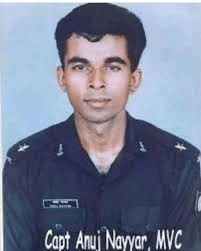 Captain Anuj Nayyar17th Battalion, The Jat Regiment